Audioclipping for complete beginners

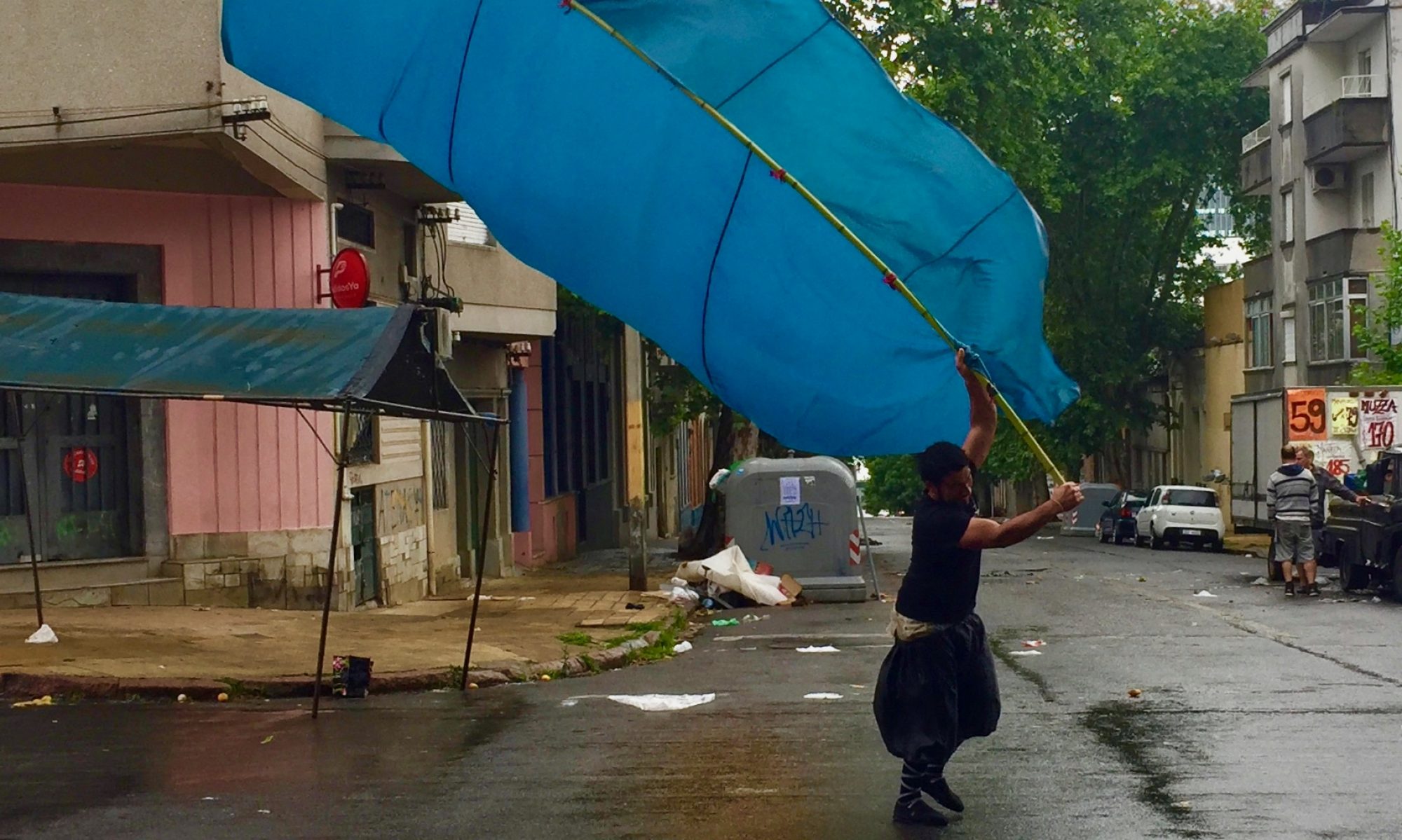
Although many people describe Montevideo as tranquilo(especially in comparison with Buenos Aires), I wouldn’t call it quiet. Like most modern cities, the noise from street traffic is a constant presence. On the other hand, there are many other sounds too, particularly emanating from the multitude of street markets. 

Earlier this year in Edinburgh, I was working a bit on urban soundscapes, and some of that perspective found its way to me here in Montevideo. Now I know nothing about technical aspects of sound recording, but in the course of wandering around, I was suddenly struck by the difference between vision and sound in the way we relate to places. It’s totally commonplace to take photographs when we see something that strikes us. Why don’t we do the same with sounds? Why don’t we take audioclips of the sounds that arise in our environment?

So over the course of a week, I made it my mini-project to capture interesting sounds in the environment.  In the absence of anything better,  I recorded via the voice memo app on my phone, making clips of anything that caught my attention. Of course, taking audioclips is not so different from making mini-videos in the sense that you are engaging with a process that unwinds over time, rather than capturing a single instant.  But the fact that the sound is the only thing you are recording somehow makes all the difference. 

A second big difference with photos comes in the quality of the recording. Most phone cameras now are pretty good and it rarely seems worth the bother to carry around a traditional camera. By contrast, I found it pretty hard to get decent audio recordings on my phone — not surprising, given that the microphone is optimised to pick up a voice right close-by while minimising background noise. 

After a week of this, my next step was to create a small ‘album’ of the sounds I’d recorded. Because of the poor quality of the recordings, I moved even further outside my comfort zone by doing some minimal editing of the clips on GarageBand, since this was already installed on my laptop. The practice of listening to the clips multiple times, while ruthlessly pruning away what seemed extraneous, created a sense of familiarity and affection for them: each time I played a particularly clip, it would evoke memories and feelings about where I was at the time. 

However, I’m also conscious of the fact that this evocation of the time and place via sound is very subjective. I’ve added a few photographs which relate to the some the audioclips, though there are a lots of missing places.

One of the audioclips was a snatch of song being played on someone’s radio, audible through an open door. It somehow tickled my curiosity and with the help of Shazam, I identified as Quién Eres Tu by Frank Reyes. A very cheesy song, but one that I have come to love.

Montevideo unchained

There are lots of little independent bookstores in Montevideo, but two of the bigger ones really impressed me: Librería Más Verso Puro and Escaramuza. Both of them have gorgeous, august interiors, full of beautiful woodwork and coloured class and a generosity of spirit.

Both of them were an echo of the time when I grew up in London, when a multitude of bookshops and libraries flourished. The fact that they seem to be still thriving in Montevideo points to the presence of an engaged and enthusiastic book-reading public. But equally, there are important absences: no chain of Waterstones (four branches currently in Edinburgh) and presumably no substantial price-undercutting (yet) from Amazon.

There seems to be parallel phenomenon with stores that sell paint, building material, ironmongery — they are much more frequent and more evenly distributed than in Edinburgh. Most independent builders merchants and DIY places in Edinburgh got eclipsed by B&Q and Homebase. B&Q used to have around seven medium-sized stores distributed across the city, then gradually closed them down and aggregated everything into two mega-stores in out-of-town shopping centres. So just picking up a can of paint or box of screws can mean a 30 minute car journey.

Now that’s not to say that there are no chains in Montevideo. Particularly in food retailing, there are a number of ‘mini-market’ and supermarket chains. But none of them seems to have the achieved the level of dominance of the big four in the UK, where Tesco, Sainsbury’s, Asda and Morrisons jointly control about 70% of the market. Maybe there’s a moral here — protecting the local economy from monopolistic chains allows a more healthy ecosystem of independent businesses to thrive, with a denser network of neighbourhood stores.

Inscribing the City

Us vs you graffiti

The significance of graffiti and street art has been much discussed. It is striking how many of the walls in Montevideo are covered with one or the other; in fact, often both at the same time. Maybe they spring from similar impulses, where creativity and rebellion vie for our attention. Painting walls offers one of the few opportunities for citizens to visibly alter the fabric of the built environment.

Time for a confession: I don’t really like most of the graffiti that I come across here. Even stronger, it often feels to me as a disfigurement of the urban environment. That said, I’m more sympathetic to expressions of political desires (often around environmental issues or gender equality) than to tagging.

So far, I haven’t seen much of a pattern in where graffiti ends up, though obviously it helps to have a large expanse of light-coloured wall. Just opposite our co-working space (Sinergia Cowork Palermo) is a large building that houses the Universidad de Trabajo de Uruguay (UTU) — a kind of technical college. It boasts a large expanse of grey wall which has received much attention from local graffitistos. I’m inclined to think that a lot of them are disaffected UTU students.

There seems to be continuum from pure graffiti to out-and-out art. The following tranche of photos starts at the graffiti end:

By contrast, this next tranche flows more into the world of art (some of it carried out by artists’ collectives):

Eat your greens!

Trying to eat a plant-based diet in Montevideo has been a challenge. As Wikipedia notes, “Beef is very important in Uruguayan cuisine and an essential part of many dishes.” Given that beef exports are a mainstay of the Uruguayan economy, this is not so surprising.

So far, I haven’t found a ‘vegetarian-friendly’ restaurant here that is both open in the evening and serves dishes focused on vegetables (as opposed, say, to veggie burgers or smoothies). However, I’m gradually discovering alternatives. On Saturday afternoon, I stumbled across a fairly substantial fruit and vegetable market (feria vecinal) on Avenida Salto, just around the corner from where I’m staying. Unfortunately I didn’t have the time or carrying-capacity to buy ingredients at that point.

Leftovers from Salto market

Later on that day, however, I headed over to Ecotiendas, a nearby organic store. It was the second time I’d been there, but I was suddenly struck by how many different kinds of leafy greens there were. I recognised cavolo nero, regular kale, chard (pictured at the top of this post), spring greens, rocket, different sorts of lettuce, but there were certainly some leaves hat I just couldn’t identify. Lots of scope for future exploration.

Selection of leafy greens at Ecotiendas

La Maleza in Montevideo

Are first impressions trustworthy? Probably both yes and no — as someone recently observed, maybe truth isn’t truth. So I’m sure some of my first responses to being in Montevideo were pretty off-target. On the the other hand, there is a delightful and poignant vividness to that first glimpse of a new place.

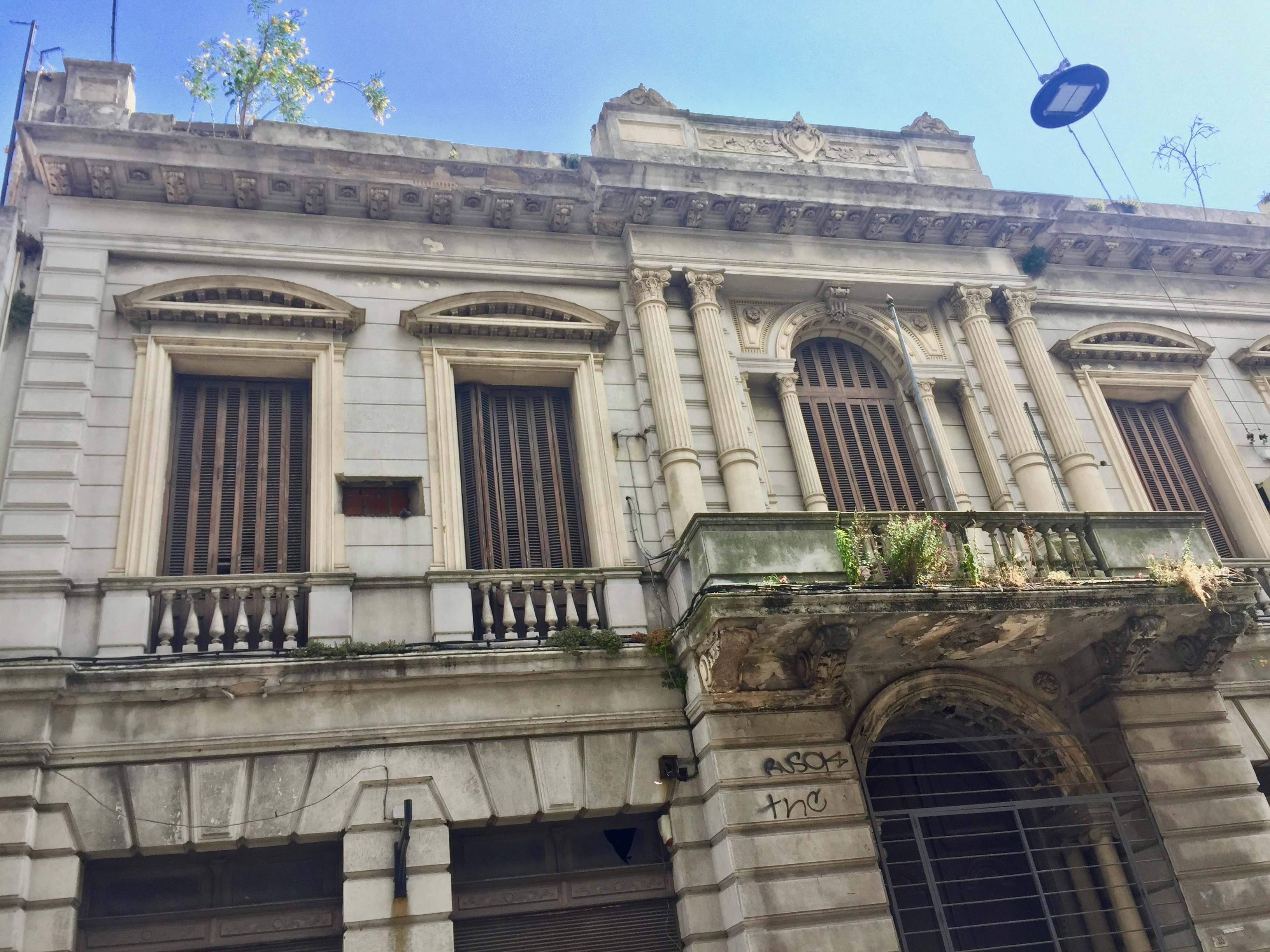
My first stroll through the Ciudad Vieja on a bright and warm spring day in November. Contrasts between the old and new — many graciously beautiful old buildings, some shockingly ugly new ones. One feature which struck me was the recurrence of vegetation sprouting from roofs and cornices of the older buildings. Some of these appeared abandoned, but others were definitely active businesses.


Is Montevideo a little dilapidated in places? Certainly. Yet it is also charming.

‘La maleza’ is one of the terms for weeds in Spanish. Funnily enough, although weed in the other sense of the work is legal in Uruguay, I smelt less of it on the streets here than I do on a typical summer day in Edinburgh.

Trash Talk

In the beginning was the void. The void gave birth to stuff. Stuff gave birth to good stuff and trash. And we threw the trash into the void. Trash gave birth to General Waste, Compostable Waste and Recyclable Waste.

Recyclable gave birth to mixed paper and cardboard. (But not those envelopes with little transparent windows. Nor used pizza boxes.) And Recyclable gave birth to metal, glass and plastics. (But not light bulbs. And certainly not plastic bags, except in some places where you can bundle them all together and put them inside another plastic bag. And probably not margarine tubs. Or least not the lids of margarine tubs.)

Compostable Waste included vegetable peelings and tea bags. (But not paper coffee cups because they are plastic-coated except for those ones which are compostable.)

And even quite intelligent people became confused and decided it was all just Trash.


I’ve been curious for a long time about the different categorisations for wasted used in my hometown of Edinburgh. The City of Edinburgh Council has slightly different ways of dividing up waste depending on whether you are using individual kerbside collections or the large communal bins. (They also periodically revise what is included in each category.) The University of Edinburgh uses different categories from the Council for their in-building waste bins, namely Paper and Cardboard vs. Dry Recycling vs. Other.

This trip has opened my eyes to yet more possibilities.

Waste bins in SFO airport. Items seem to be distributed more or less randomly between the three bins.

Waste bins with illustrative icons in Vancouver International Airport. Stuff mostly ends up in the Trash category.

Waste bins with example items at CIRS, UBC, Vancouver

Waste bins at the Cardboard House Bakery, Hornby Island, BC. Rightmost bin is for pizza boxes.

Redemption centre for recycling in Vanderbilt Avenue, Brooklyn, NY. Providing a cash incentive for different categories of trash probably works really well.

Unceded territory

We are staying a few days at a hotel: Kingfisher Oceanside Resort and Spa near the small town of Comox on Vancouver Island. Like much of the Pacific North West Coast, this area is known as unceded territory. It is a notion with many complexities, but broadly speaking, it arises from the fact that in many parts of Canada, the British Crown authorities failed to agree land treaties with indigenous peoples. As a result, the First Nations consider that their traditional rights to the lands and natural resources have the same legitimacy as they had before the coming of European settlers. And in this spirit, we respectfully acknowledge that we are currently standing on the Unceded traditional territory of the K’òmoks First Nation.

The hard reality is that the coast here is heavily occupied with suburban houses set in woodland gardens. The grounds of the Kingfisher Resort are carefully manicured, replete with flowering shrubs, water features and (largely decorative) fire pits. And yet. Step down to the shoreline and you are in different, strangely magical world, a limininal space that is under the dominion of the tides.

Yesterday, we decided to defy the proposition that the only options for lunch were the Kingfisher Aqua bistro or getting into a car (which we haven’t got). We started by clambering over the rocky shoreline, inspired by a sign which claimed (over-optimisticly) that there was 1km footway to the nearby hamlet of Gartley. Along the way, we encountered myriads of tiny crabs that scuttled away in panic as we approached.

Lunch at Roy’s Towne Pub

Once we reached Gartley, we asked directions for Royston, which according to the map appeared to have a small store and a pub that served food. Our informant was somewhat incredulous when we volunteered that we planned to walk there, but pointed us in the right direction. After a rapid and nervous 10min promenade along the edge of Island Highway South, accompanied by fast-moving 4x4s and biker posses, and negotiating a narrow bridge over the Trent River, we ended up at Roy’s Towne Pub. This turned out to have a charming, sunlit patio and an imaginative menu that vastly exceeded our expectations.


For our return journey, we ventured back to the shore in the hope that we could avoid the highway. We clambered over more rocky inclines that opened out to the broad estuary of the Trent, the sea still far out in the distance. We skirted huge, ornately weathered pine logs washed up against the sand and shingle. We gingerly waded across the weed-strewn shallows of the Trent debouching into the bay, hoping that no menaces were lurking hidden under the green fronds. Triumphantly across the river, we soon realised that we had only crossed one of several outlet streams, and paddled a few more times through tepid, weedy streams. Despite finding a small path through the grasses that ran close to the treeline, it was still unclear where we were or how many obstacles were still to be traversed. When we eventually returned to leafy paved road, we realised that we had spent over an hour circuitously covering the same as-the-raven-flies distance as our earlier 10 min trot along the highway.

Beyond Bread

The weather app on my phone lets me select “favourite” locations for weather forecasts. At the moment, it looks like this:

It’s currently 16C in Vancouver and over the next few days, all my “favourite” places (including Edinburgh) are predicting significantly warmer weather than where we are.

We are comforting ourselves by going for early morning coffee in Beyond Bread, which has become our favourite go-to place on West 4th Avenue, less than 10 minutes stroll from our temporary home on Point Grey Road.

Indulgent breakfast in Beyond Bread

Macchiato, single-shot-cappucino with fresh cashew nut milk, plain croissant and monkey bread (“cinnamon orange pull-apart croissant”). Who cares about the weather anyhow?

Down-and-out downtown

We visited Vancouver downtown today. Managed to figure out where the buses ran, accumulated 2 x $2.85 CAD in change, and took the 30 min ride over Granville Bridge to Gastown, a popular tourist destination within the city.

Overall, probably fair to say that we were a little underwhelmed, although Gastown does boast some cool clothes boutiques, hipster bars and heavily used bike paths. Despite the fact that it won’t officially be legalised in Canada until October this year, marijuana was also much in evidence, and we passed a number of retail outlets for this recreational drug.

The most distressing aspect of the city was the number of homeless people on the streets. Some of them withdrawn into doorways, others gathering together on the sidewalk, but overall a palpable sense of distress and affliction. As in many places, lack of affordable housing seems to be a key driver in the steadily increasing number of citizens who are down and out on the streets.

Walking with Sea Wolves

Point Lobos is one of our favourite places in the vicinity of Santa Cruz, and one that we’ve visited on several occasions. The name comes from a rocky outcrop where the sound of “sea wolves” (sea lions) carries inland.

By happy coincidence, we arrived in time for a guided walk by a wonderfully knowledgable expat Brit, Peter Fletcher. We would never have guessed that a untidy heap of branches and foliage in the coastal scrub was the residence of a dusky-footed woodrat. Or that the red rust covering branches of Monterey cypresses by the coast was a rare form of algae called Trentepohlia that only thrives in areas where the air is extremely pure and unpolluted.

Peter pointed out that the Monterey cypress casts a lot of shade, and we could confirm that they were also pretty effective in blocking out the very weak sunlight on a misty, driech day. So we shivered. But it was worth it.