Audioclipping for complete beginners

Although many people describe Montevideo as tranquilo(especially in comparison with Buenos Aires), I wouldn’t call it quiet. Like most modern cities, the noise from street traffic is a constant presence. On the other hand, there are many other sounds too, particularly emanating from the multitude of street markets. 

Earlier this year in Edinburgh, I was working a bit on urban soundscapes, and some of that perspective found its way to me here in Montevideo. Now I know nothing about technical aspects of sound recording, but in the course of wandering around, I was suddenly struck by the difference between vision and sound in the way we relate to places. It’s totally commonplace to take photographs when we see something that strikes us. Why don’t we do the same with sounds? Why don’t we take audioclips of the sounds that arise in our environment?

So over the course of a week, I made it my mini-project to capture interesting sounds in the environment.  In the absence of anything better,  I recorded via the voice memo app on my phone, making clips of anything that caught my attention. Of course, taking audioclips is not so different from making mini-videos in the sense that you are engaging with a process that unwinds over time, rather than capturing a single instant.  But the fact that the sound is the only thing you are recording somehow makes all the difference. 

A second big difference with photos comes in the quality of the recording. Most phone cameras now are pretty good and it rarely seems worth the bother to carry around a traditional camera. By contrast, I found it pretty hard to get decent audio recordings on my phone — not surprising, given that the microphone is optimised to pick up a voice right close-by while minimising background noise. 

After a week of this, my next step was to create a small ‘album’ of the sounds I’d recorded. Because of the poor quality of the recordings, I moved even further outside my comfort zone by doing some minimal editing of the clips on GarageBand, since this was already installed on my laptop. The practice of listening to the clips multiple times, while ruthlessly pruning away what seemed extraneous, created a sense of familiarity and affection for them: each time I played a particularly clip, it would evoke memories and feelings about where I was at the time. 

However, I’m also conscious of the fact that this evocation of the time and place via sound is very subjective. I’ve added a few photographs which relate to the some the audioclips, though there are a lots of missing places.

One of the audioclips was a snatch of song being played on someone’s radio, audible through an open door. It somehow tickled my curiosity and with the help of Shazam, I identified as Quién Eres Tu by Frank Reyes. A very cheesy song, but one that I have come to love.

On locals and mate

One of the appealing things about Montevideo is that it does not seem to be a tourist destination. Maybe it’s just that little bit too far away from the centre of the world (Edinburgh) or too close to Antarctica. Either way there is an irrational pleasure in feeling less like a tourist and more like a (temporary) resident.

Having said that, it’s hard to distinguish tourists from locals solely on the basis of physiognomy. Apparently 88% of Montevideo’s inhabitants are in some way or other of European descent, so on the whole Ewan and I blend in. But there is one tell-tale thing that sets the locals apart: mate (Spanish pronunciation required here!)

There are some coffee cafés in Montevideo (like our favourite, Café Gourmand) but they are generally few and far between; and you can probably find tea if you persevere. But Montevideanos don’t seem to bother with either: they start, spend and finish their day with mate.

Mate is prepared by pouring hot (but not boiling) water over dried, ground mate leaves (yerba) in a gourd (traditionally) or a roundish cup; the resulting mixture quickly turns into a kind of slushy mush that would leave you with a mouthful of pulp if it wasn’t for the bombilla, a tube with holes which functions both as a sieve and a straw. Montevideanos are born with a silver bombilla in their mouth.

Mate is not served at cafés, for the simple reason that locals do not want to be parted from it. They carry it wherever they go so they can take sips throughout the day. To make sure that they don’t run out of mate, they clutch a large thermos flask filled with hot water under their armpit (same arm that carries the cup) for continuous top-ups. And if their thermos runs out of hot water they knock on the nearest door and the person opening it has to fill it up again straight away. Ok I am making that last bit up, but it may be true. Mate is an important part of social glue in Uruguay, and cups are shared around in groups as a kind of bonding ritual.

A local demonstrates a novel way of carrying mate + thermos (armpits remain more popular)

We chat about mate to the person at the front desk of Skyline who buzzes us through to the building. He is a friendly guy in his forties with stargazer eyes, and he is currently reading the second volume of a hefty biography of Fidel Castro. We like him! We set out our questions about mate in tentative Spanish but he quickly, unobtrusively switches to his much more competent English. He relates how, as a student, he drank three flask-fulls a day, slept badly and eventually developed palpitations and stomach pains that told him to cut down. He now knows his limit…  He tells us, with some regret, that he would let us have a sip of his mate (which is sitting right next to him on his desk, obviously –  he’s a local) but that we would need to have our own bombilla, for hygiene reasons. 

Fair enough. Especially since mate actually looks pretty disgusting, while the coffee at Café Gourmand does not. There seems to be a limit to living like a local. But after a few days in Montevideo, mate cups and thermos flasks look as familiar as coffee-on-the-go in London,

Kiss!

My alarm goes off on 3:30 am on Saturday morning. It’s a repeat of the alarm set for 3:30 am the day before, and it tells me that I’ve been travelling for 24 hours. My soul is still lagging behind but my body, at least, is in Skyline, my home for the next few weeks, with Ewan, my lifetime home. Ewan stayed up waiting for me; the 3:30 alarm tells us is time for bed!

In the morning, a little shivery with the shock of travelling 7,001 miles, we set off for one of Ewan’s favourite cafés, Cafe Gourmand, for coffee (urgent) and a chance to practise some Spanish, in a live situation. I have been spending a bit of time every day with Paul Noble (he does not know this) – a great teacher for me because he understands my need for much repetition and endless patience. One of the first words I learned on Paul’s course was ‘quisiera’, or ‘I would like…’, which strikes me as an excellent way into a conversation. Paul’s course is speaking only, and my memory bridge for ‘quisiera’ looks like ‘kiss-iera’. I would like a kiss, yesterday!

Walking into Cafe Gourmand, I’m only slightly taken aback when the young woman behind the counter walks right up to me and kisses me. She seems genuinely delighted to see me. And I know, in that instant, that I’m not just in a different country but also on a different continent.

Later on, as I start tracing the Montevideo grid for the first time (when it comes to finding my way, I also need much repetition and endless patience and repetition), we pass a place that has ‘Yoga’ written in the window. The tall vibrantly-blue front door is open and I hear sounds coming from inside. As yoga is my second most-urgent need, I walk inside and climb the narrow wooden stairs. I am met at the top by a woman with warm eyes who greets me, again, with a kiss, as if we are old friends, and she was expecting me, might even have been waiting for me, but forgives my lateness as she knows I have already swapped Anglo-saxon punctuality for Latin American not-so-fussed-about-it.

Yes! My first sentence starts with ‘Kiss-iera’. And yes, I manage a very small conversation (committing only about 10 errors) from which I manage to extract ‘Lunes y Mercioles, a las cuatro de la tarde’. If only Paul knew – he would be so proud of me…

Yoga door is shut. But what a beautiful door.

My upsurge of confidence gets a small knock when I arrive on Monday at 4 pm to find the beautiful blue door firmly locked. There is no bell. Did I get it wrong? Or did they decide that today was not really a good day for yoga, after all?

Who cares? I am in Uruguay, my yoga mat lies waiting silently at Skyline, and I’m ready to be kissed again.

Montevideo unchained

There are lots of little independent bookstores in Montevideo, but two of the bigger ones really impressed me: Librería Más Verso Puro and Escaramuza. Both of them have gorgeous, august interiors, full of beautiful woodwork and coloured class and a generosity of spirit.

Both of them were an echo of the time when I grew up in London, when a multitude of bookshops and libraries flourished. The fact that they seem to be still thriving in Montevideo points to the presence of an engaged and enthusiastic book-reading public. But equally, there are important absences: no chain of Waterstones (four branches currently in Edinburgh) and presumably no substantial price-undercutting (yet) from Amazon.

There seems to be parallel phenomenon with stores that sell paint, building material, ironmongery — they are much more frequent and more evenly distributed than in Edinburgh. Most independent builders merchants and DIY places in Edinburgh got eclipsed by B&Q and Homebase. B&Q used to have around seven medium-sized stores distributed across the city, then gradually closed them down and aggregated everything into two mega-stores in out-of-town shopping centres. So just picking up a can of paint or box of screws can mean a 30 minute car journey.

Now that’s not to say that there are no chains in Montevideo. Particularly in food retailing, there are a number of ‘mini-market’ and supermarket chains. But none of them seems to have the achieved the level of dominance of the big four in the UK, where Tesco, Sainsbury’s, Asda and Morrisons jointly control about 70% of the market. Maybe there’s a moral here — protecting the local economy from monopolistic chains allows a more healthy ecosystem of independent businesses to thrive, with a denser network of neighbourhood stores.

Inscribing the City

Us vs you graffiti

The significance of graffiti and street art has been much discussed. It is striking how many of the walls in Montevideo are covered with one or the other; in fact, often both at the same time. Maybe they spring from similar impulses, where creativity and rebellion vie for our attention. Painting walls offers one of the few opportunities for citizens to visibly alter the fabric of the built environment.

Time for a confession: I don’t really like most of the graffiti that I come across here. Even stronger, it often feels to me as a disfigurement of the urban environment. That said, I’m more sympathetic to expressions of political desires (often around environmental issues or gender equality) than to tagging.

So far, I haven’t seen much of a pattern in where graffiti ends up, though obviously it helps to have a large expanse of light-coloured wall. Just opposite our co-working space (Sinergia Cowork Palermo) is a large building that houses the Universidad de Trabajo de Uruguay (UTU) — a kind of technical college. It boasts a large expanse of grey wall which has received much attention from local graffitistos. I’m inclined to think that a lot of them are disaffected UTU students.

There seems to be continuum from pure graffiti to out-and-out art. The following tranche of photos starts at the graffiti end:

By contrast, this next tranche flows more into the world of art (some of it carried out by artists’ collectives):

Eat your greens!

Trying to eat a plant-based diet in Montevideo has been a challenge. As Wikipedia notes, “Beef is very important in Uruguayan cuisine and an essential part of many dishes.” Given that beef exports are a mainstay of the Uruguayan economy, this is not so surprising.

So far, I haven’t found a ‘vegetarian-friendly’ restaurant here that is both open in the evening and serves dishes focused on vegetables (as opposed, say, to veggie burgers or smoothies). However, I’m gradually discovering alternatives. On Saturday afternoon, I stumbled across a fairly substantial fruit and vegetable market (feria vecinal) on Avenida Salto, just around the corner from where I’m staying. Unfortunately I didn’t have the time or carrying-capacity to buy ingredients at that point.

Leftovers from Salto market

Later on that day, however, I headed over to Ecotiendas, a nearby organic store. It was the second time I’d been there, but I was suddenly struck by how many different kinds of leafy greens there were. I recognised cavolo nero, regular kale, chard (pictured at the top of this post), spring greens, rocket, different sorts of lettuce, but there were certainly some leaves hat I just couldn’t identify. Lots of scope for future exploration.

Selection of leafy greens at Ecotiendas

La Maleza in Montevideo

Are first impressions trustworthy? Probably both yes and no — as someone recently observed, maybe truth isn’t truth. So I’m sure some of my first responses to being in Montevideo were pretty off-target. On the the other hand, there is a delightful and poignant vividness to that first glimpse of a new place.

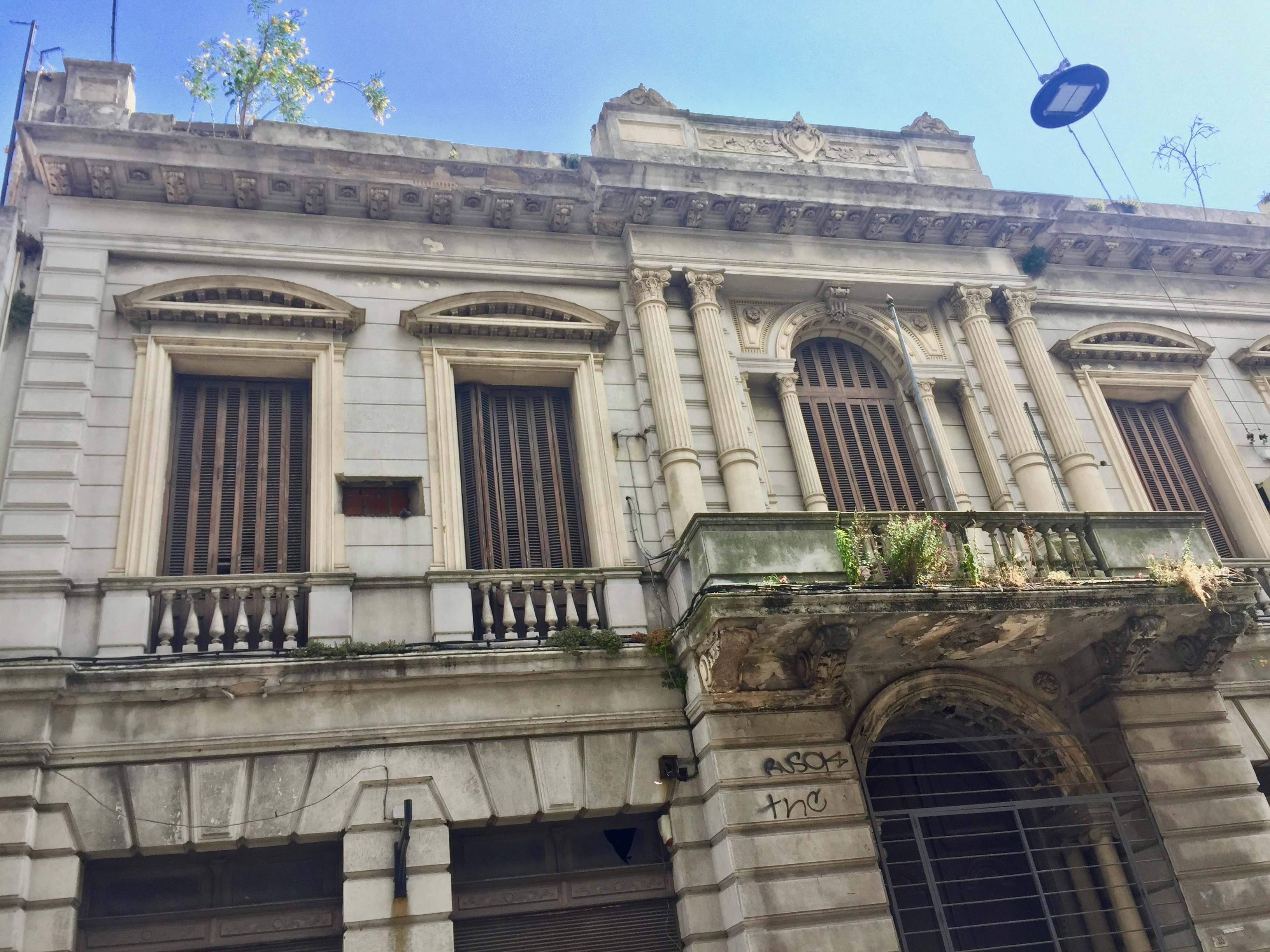
My first stroll through the Ciudad Vieja on a bright and warm spring day in November. Contrasts between the old and new — many graciously beautiful old buildings, some shockingly ugly new ones. One feature which struck me was the recurrence of vegetation sprouting from roofs and cornices of the older buildings. Some of these appeared abandoned, but others were definitely active businesses.


Is Montevideo a little dilapidated in places? Certainly. Yet it is also charming.

‘La maleza’ is one of the terms for weeds in Spanish. Funnily enough, although weed in the other sense of the work is legal in Uruguay, I smelt less of it on the streets here than I do on a typical summer day in Edinburgh.